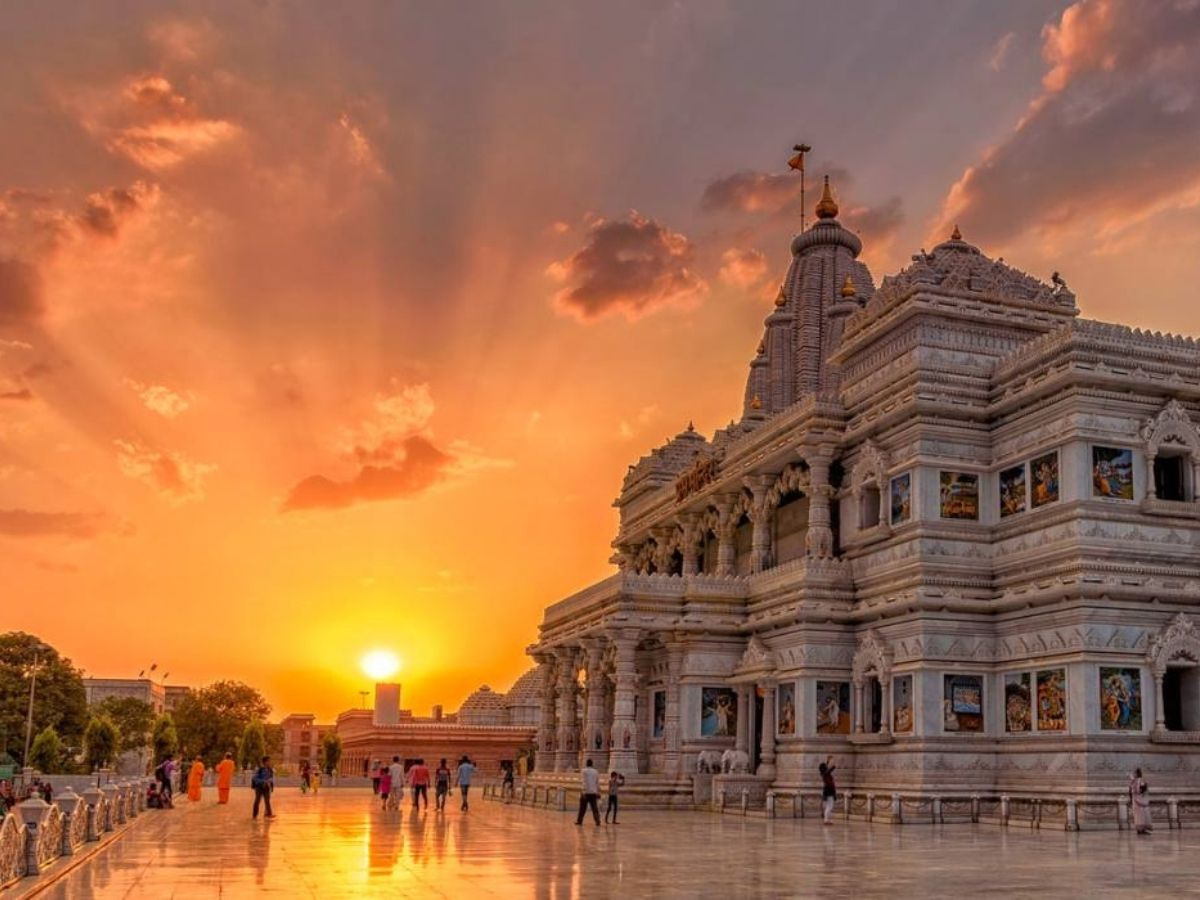
Prem mandir Vrindavan
logo

The Radhe Krishna Dham

The Radhe Krishna Dham offering Best Plots in Mathura With Green Area Near By National Highway At Best Price.

Menu

Gen Z Pilgrimage Reset: Why Mathura-Vrindavan Is Becoming a Youth Travel Destination in 2026

SEO Title: Gen Z Pilgrimage Reset: Why Mathura-Vrindavan Is Becoming a Youth Travel Destination in 2026 Meta Description: Discover why Gen Z is turning to Mathura-Vrindavan for short spiritual escapes, cultural experiences and digital detox in 2026, and what this means for Braj's future. Focus Keyphrase: Gen Z spiritual tourism in Mathura-Vrindavan Secondary Keywords: Mathura Vrindavan tourism 2026, spiritual tourism India, Gen Z travel trends 2026, Mathura investment, Vrindavan development, Braj tourism, property investment in Mathura, short spiritual trips India Suggested Slug: gen-z-spiritual-tourism-mathura-vrindavan-2026

What If the Next Big Travel Trend Isn't a Beach, Hill Station or Café?

For years, India's youth travel culture has been associated with mountains, beaches, music festivals, cafés and weekend road trips. But something interesting is happening in 2026. A growing number of young Indians are adding something very different to their travel plans: spiritual destinations. Not necessarily as traditional pilgrims. Not necessarily for long religious journeys. And increasingly, not even for a conventional holiday. Instead, young travellers are looking at places such as Mathura, Vrindavan, Varanasi, Ayodhya and Rishikesh as places to slow down, reconnect with culture, take a break from digital noise and experience something that feels more meaningful. This emerging behaviour could be especially significant for Mathura-Vrindavan, where spirituality, heritage, food, music, architecture and rapidly developing infrastructure already intersect. The interesting question is not simply: “Why are young people visiting temples?” The more important question is:

“Why is an always-online generation beginning to travel towards places that encourage them to slow down?”


The 2026 Traveller Is Looking for More Than a Photograph

Travel behaviour among younger Indians is changing. A 2026 report on Gen Z travel found that seven in ten young travellers would prefer several shorter trips rather than one long annual holiday. The same report highlighted a strong preference for personalised experiences, spontaneous travel and destinations that are not simply chosen because they have gone viral online. That creates an interesting opportunity for destinations like Mathura. A weekend in Braj can become more than a checklist of famous locations. It can include:
  • Morning darshan
  • Walking through old lanes
  • Local Braj food
  • Yamuna-side experiences
  • Temple architecture
  • Cultural performances
  • Local markets
  • Photography
  • Spiritual music
  • Heritage exploration
  • Quiet personal time
This is a different type of tourism. It is less about “How many places can I cover?” And more about: “How did this place make me feel?” That distinction matters enormously for the future of spiritual destinations.

Gen Z Is Bringing a New Meaning to Spiritual Tourism

According to recent redBus data reported in 2026, Gen Z and young travellers accounted for more than 53% of travel to spiritual destinations in India during FY26. The report also points towards digital discovery and last-minute booking behaviour as important factors in this growing participation. That does not mean every young traveller suddenly wants a traditional pilgrimage. Instead, spirituality is becoming part of a broader travel experience. For one person, it could mean attending aarti. Another, it could mean sitting quietly beside the Yamuna. Someone else, it might mean exploring Braj's mythology and architecture. And for another traveller, it may simply be a two-day escape from a city filled with notifications, traffic and screens. This is where Mathura-Vrindavan has a unique advantage. It does not need to manufacture an identity for this audience. The identity already exists. The opportunity is to make that identity accessible to a generation that experiences the world through smartphones, short-form videos, maps, reviews and instant bookings.

The “Spiritual Reset” Could Become the New Weekend Getaway

Imagine a young professional in Delhi-NCR. Monday to Friday is work. Meetings. Emails. Traffic. Notifications. Screens. Then Friday evening arrives. Instead of another mall, café or conventional resort, they decide to travel to Mathura-Vrindavan for two days. Saturday begins with a temple visit. Then comes local food, a heritage walk, photography and time around the cultural landscape of Braj. Sunday is slower. No packed itinerary. No pressure to visit ten attractions. Just a change of environment. This is what we can call the “spiritual reset”: a short journey designed not only for sightseeing but for mental and cultural reconnection. It is an emerging travel concept worth watching because it fits perfectly with the short-trip behaviour increasingly visible among younger travellers. And Mathura is naturally positioned for it.

Why Mathura-Vrindavan Is Particularly Interesting in 2026

The youth tourism story becomes even more interesting when it meets infrastructure development. Mathura-Vrindavan is not developing in isolation. The broader Braj region is being shaped by tourism, connectivity, hospitality and infrastructure initiatives. Recent reporting has highlighted a significant pipeline of infrastructure activity around the Vrindavan region, with estimates putting planned and executing infrastructure signals at around ₹7,000 crore. Importantly, however, announced projects should not automatically be treated as completed projects. Their actual impact depends on execution, timelines and utilisation. Connectivity is another important piece of the puzzle. A proposed ₹1,645-crore, 15-km link connecting the Yamuna Expressway with the Delhi-Agra Highway in Mathura is designed to improve regional connectivity, including a six-lane road, a Yamuna bridge and multi-level parking. For tourism, better connectivity can change something fundamental: How easy it feels to make the trip. And convenience often determines whether a destination becomes an occasional pilgrimage or a repeat weekend experience.

From Temple Visit to Cultural Experience

One of the biggest opportunities for Mathura is that its appeal does not end at its temples. The Braj region contains a much larger cultural ecosystem. Mathura. Vrindavan. Govardhan. Barsana. Nandgaon. Gokul. Mahaban. Baldev. These destinations form part of Uttar Pradesh's Krishna/Braj tourism framework. For younger travellers, this creates the possibility of turning a single destination into a multi-experience journey. Instead of: “Let's visit Vrindavan.” The trip becomes: “Let's experience Braj.” That is a much bigger tourism proposition. It can include mythology, food, music, architecture, festivals, local crafts, history, nature and spirituality. And it creates reasons for visitors to stay longer, return more frequently and explore beyond the most famous locations.

The Digital Detox Paradox

Here is perhaps the strangest part of this trend. Gen Z discovers destinations through the internet. They search on Google. They watch Reels. It save Instagram locations. They check reviews. They use digital maps. And then they travel to places where they may intentionally want to use their phones less. That is the paradox. Technology is helping young people discover places that help them temporarily escape technology. Mathura-Vrindavan fits beautifully into this paradox. A traveller may discover a temple through a Reel, research the history through YouTube, book accommodation online and then arrive in Braj looking for something that cannot be completely captured on a screen. The physical experience becomes the product. And that is increasingly valuable in a world where digital content is abundant but genuine experiences remain scarce.

What Does This Mean for Property in Mathura?

This is where tourism and real estate begin to overlap. A growing destination does not only need places to visit. It needs places to stay. It needs restaurants. Homestays. Hotels. Rental homes. Second homes. Guest accommodation. Service providers. Retail. Parking. Maintenance. Local transportation. And residential communities. The growth of hospitality interest in Vrindavan is already visible, with Royal Orchid Hotels announcing a new Regenta Z property in Vrindavan, citing the growing influx of pilgrims and leisure travellers. That does not automatically mean every property in the region will appreciate equally. That would be an irresponsible conclusion. Location, title clarity, approvals, infrastructure, accessibility, development quality and actual demand all matter. But it does suggest something important:

The economic story of Braj is gradually becoming larger than pilgrimage alone.


Why This Could Matter to a First-Time Property Buyer

For someone considering property in Mathura, the more useful question may not be: “Will prices rise?” Nobody can guarantee that. A better question is:

“What is changing around the location I am considering?”

Look at the fundamentals. 1. Connectivity How easily can people reach the property? 2. Tourism demand Are visitors coming only during major festivals, or throughout the year? 3. Hospitality growth Are hotels, stays and visitor facilities expanding? 4. Infrastructure execution Are announced projects actually progressing? 5. Local ecosystem Are shops, healthcare, roads, utilities and everyday services improving? 6. Long-term usability Could the property work as a residence, second home, rental property or future family asset? These questions create a much stronger decision framework than simply chasing a headline saying that a particular city is “the next big investment destination.”

The Bigger Shift: From Pilgrimage City to Experience City

This may be the most important change to watch. For generations, Mathura-Vrindavan has primarily been understood through the lens of devotion. That identity will remain central. But tourism itself is becoming broader. A visitor can be spiritual and curious. Traditional and digital. Young and devotional. A traveller can come for Krishna, stay for the culture and return because the city gave them a sense of pause. That combination is powerful. The future of Mathura may therefore not be about replacing its spiritual identity. It may be about expanding the meaning of that identity for a new generation.

What Could the Next Five Years Look Like?

If the current direction continues, Mathura-Vrindavan could increasingly evolve into a destination where several types of visitors overlap:

The Devotee

Travelling primarily for faith and darshan.

The Cultural Traveller

Interested in Braj's history, architecture, music and traditions.

The Weekend Explorer

Looking for a short escape from Delhi-NCR and nearby cities.

The Wellness Traveller

Searching for quiet, reflection and slower experiences.

The Young Digital Traveller

Discovering destinations through social media but looking for experiences beyond the screen.

The Property Owner

Looking at Mathura not only as a place to visit, but as a place to own an asset. When these audiences begin occupying the same ecosystem, the economic character of a destination can change.

The Real Opportunity May Be “Living Near What People Travel To Experience”

This is an idea that deserves more attention. Real estate is traditionally discussed through roads, prices, returns and appreciation. But another factor matters: experience proximity. If people repeatedly travel to a particular region because they value its culture, spirituality and lifestyle, properties within a well-connected and properly developed ecosystem can potentially benefit from that broader demand. That does not make every plot or property a good investment. It simply means the reason to evaluate property can become broader than speculation. For some buyers, owning property near a destination they regularly visit may have lifestyle value even before financial value is considered. And that is particularly relevant for second-home buyers and families looking for a connection with Braj.

A New Generation Is Asking a Different Travel Question

The old travel question was: “Where should we go?” The newer question may be: “How do we want to feel when we come back?” That is why the rise of youth spiritual tourism deserves attention. Recent data indicates that young travellers are already becoming a major force in India's spiritual travel market. For Mathura-Vrindavan, the opportunity is unusually rich because the region combines an established spiritual identity with a rapidly evolving tourism and infrastructure ecosystem. The next chapter may therefore not be about making Mathura look like another modern tourist city. It may be about allowing a new generation to experience Braj in its own way. Less checklist. More connection. Less “destination unlocked.” More “experience remembered.” And perhaps that is the most interesting investment story of all.

Final Thought

The future of Mathura may not be built only by people who come here to invest. It may also be shaped by a generation that first comes here to escape, explore, reflect and experience. Some will visit for a weekend. Some will return every year. It may eventually choose to stay longer. And a few may eventually decide to own a piece of the place they have grown attached to. That is why the rise of Gen Z spiritual tourism is worth watching closely. Because when a travel destination becomes part of someone's lifestyle, its story can become much bigger than tourism.

Thinking About Owning Property in Mathura?

Before making any property decision, evaluate location, title and documentation, approvals, infrastructure, connectivity, utilities and the actual development status of the project. For buyers exploring residential plot opportunities in Mathura, The Radhe Krishna Dham offers plotted development designed around the growing residential and tourism ecosystem of the region. Visit the official project website to explore the current project details and available information. The Radhe Krishna Dham | Mathura, Uttar Pradesh
 

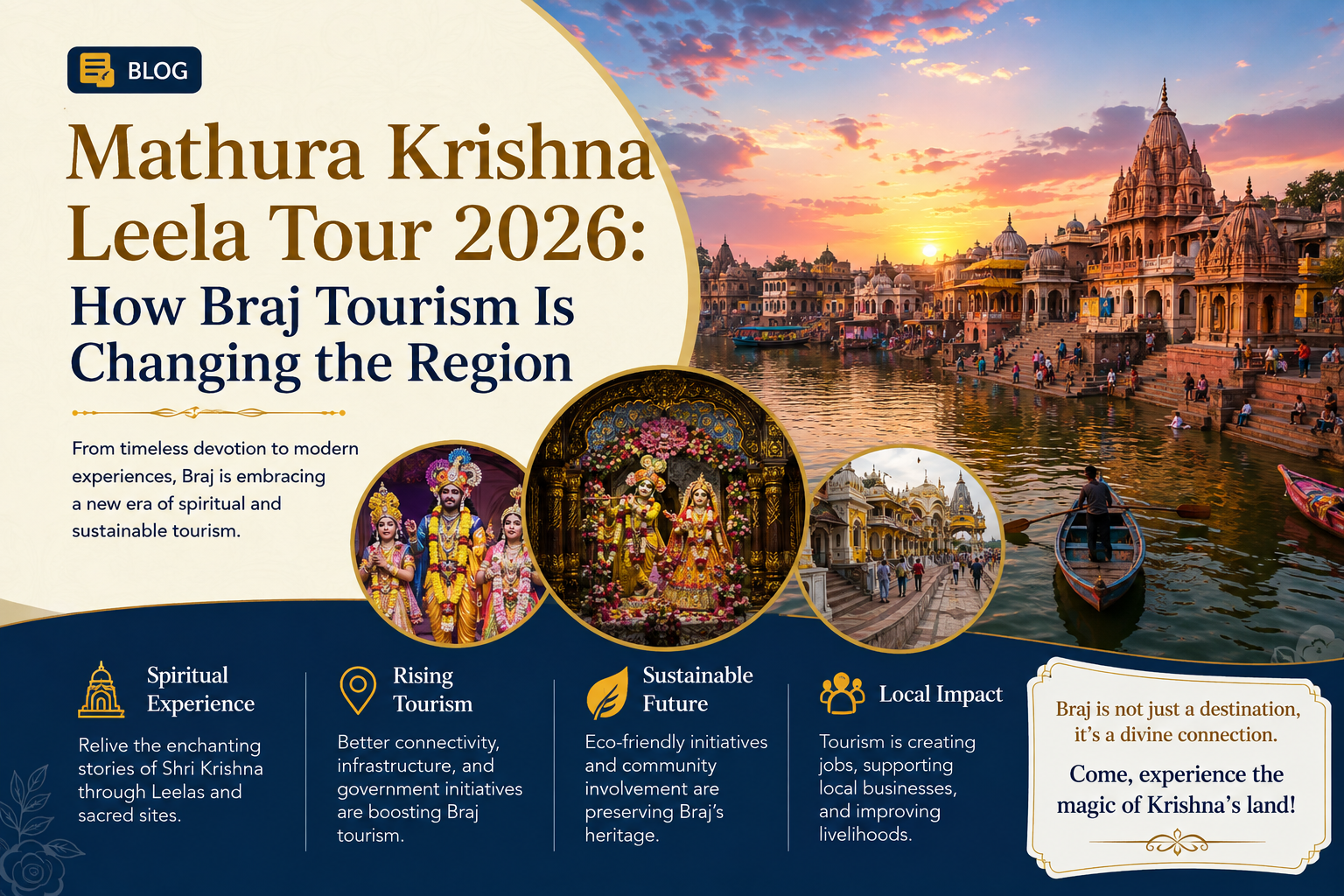
Mathura Krishna Leela Tour 2026: How Braj Tourism Is Changing the Region

Introduction: Braj Is Being Experienced Differently in 2026

For centuries, people have travelled to Mathura and Vrindavan seeking darshan, peace and a connection with the stories of Shri Krishna. But the way people experience Braj is changing. In August 2026, the Uttar Pradesh State Tourism Development Corporation launched a three-day Krishna Leela tour package connecting Mathura, Vrindavan, Gokul and Barsana. The package is designed around guided sightseeing, accommodation, refreshments and local transfers, bringing several important destinations of Braj together as one travel experience. Continue reading "Mathura Krishna Leela Tour 2026: How Braj Tourism Is Changing the Region"

Braj Heritage Fest 2026: Why Mathura’s Cultural Growth Matters for Real Estate

Introduction

What happens when a city's culture becomes one of its biggest growth engines?

That is an interesting question for Mathura in 2026.

Mathura and Vrindavan have always been places of devotion. Millions of people associate the region with Shri Krishna, Radha Rani, temples, festivals, music and the traditions of Braj.

However, something broader is happening now.

The region's cultural identity is increasingly being supported by organised tourism, heritage initiatives and infrastructure development. In July 2026, the Government of India reported that development work in the Mathura–Vrindavan Mega Tourist Circuit and infrastructure at Govardhan are among the spiritual-corridor initiatives being supported through tourism programmes.

At the same time, Braj Heritage Fest 2026 is bringing young people, schools, artists and families into activities centred around Braj's cultural traditions. The official event programme includes Krishna quizzes, Vedic storytelling, classical dance, folk dance, devotional singing, painting, rangoli and other competitions.

So, is this simply about culture?

Not entirely.

For property buyers, it raises a bigger question:

Can the growing cultural and tourism ecosystem influence where people choose to live, visit and invest?


What Is Braj Heritage Fest 2026?

Braj Heritage Fest is an annual cultural initiative associated with Vrindavan Chandrodaya Mandir.

The 2026 edition is designed to encourage children and young people to engage with Braj's traditions through creative and educational activities. The official programme includes events such as:

  • Krishna Quiz
  • Vedic Storytelling
  • Classical Dance
  • Folk Dance
  • Devotional Singing
  • Painting
  • Colouring
  • Instrumental Music
  • Rangoli
  • Sanskrit and cultural activities

The organisers describe it as an event celebrating and glorifying the heritage of Braj.

This matters because cultural tourism isn't only about temples.

It is also about experiences.

Visitors increasingly want to experience the food, music, festivals, stories, art and traditions associated with a destination.

And Mathura has an enormous cultural story to tell.


Why Cultural Tourism Matters for Mathura

Tourism creates a chain reaction.

A visitor doesn't only visit a temple.

They may also need:

Transport → Accommodation → Food → Shopping → Entertainment → Local Services

As visitor activity expands, businesses and service providers respond.

Hotels need employees.

Restaurants need staff.

Retailers need locations.

Tour operators need offices.

Families working in these sectors need housing.

That is why tourism can have an indirect effect on the wider property ecosystem.

It doesn't mean every plot will automatically appreciate.

Location, legal status, infrastructure and demand still matter.

But a growing tourism ecosystem can create a stronger economic environment around a destination.


Mathura's Development Story Is Becoming Bigger

The cultural revival is happening alongside infrastructure development.

The Ministry of Culture reported in July 2026 that the Mathura–Vrindavan region has projects including a Tourist Facilitation Centre, development of the Mathura–Vrindavan Mega Tourist Circuit, and infrastructure development at Govardhan.

The Mathura-Vrindavan Development Authority also lists ongoing projects, schemes and current development activity on its official platform.

This combination is worth watching:

Culture + Tourism + Infrastructure + Residential Demand

Together, these factors can gradually reshape how people perceive a city.


A New Generation Is Experiencing Braj Differently

There is another interesting change.

Braj's cultural identity is reaching younger audiences through events, social media, short-form videos, cultural programmes and experiences.

The official Braj Heritage Fest programme itself includes activities designed for school-age participants, ranging from painting and music to Krishna quizzes and storytelling.

This matters because younger generations are not necessarily experiencing Mathura only as a traditional pilgrimage destination.

They can experience it as:

  • A cultural destination
  • A weekend destination
  • A spiritual retreat
  • A heritage destination
  • A place for family experiences
  • A potential future home

That shift can influence future housing preferences.


Could This Increase Interest in Residential Plots?

Potentially, yes, but buyers should understand the distinction between interest and guaranteed appreciation.

A destination that attracts more visitors and develops its infrastructure can become more attractive to businesses and residents.

However, property appreciation isn't automatic.

A plot's potential depends on several factors:

Location

How easily can people reach the property?

Infrastructure

Are roads and essential services developing around it?

Legal Status

Are the title, registry and land-use details properly verified?

Community Planning

Does the development offer organised infrastructure?

Supply and Demand

Are people actually looking to buy or live in the area?

These questions are more important than simply following a trend.


Why Families Are Looking Beyond Apartments

Modern families increasingly want flexibility.

An apartment provides a ready-built home, but a plot offers something different:

Choice.

A family can decide later:

  • What kind of house to build
  • How much space to use
  • Whether to include a garden
  • How to design rooms
  • When construction should begin

For families who aren't ready to construct immediately, land can also provide a longer planning horizon.

This is one reason Residential Plots in Mathura can appeal to both end-users and long-term buyers.


The Spiritual Lifestyle Factor

There is also an emotional dimension to Mathura that conventional property analysis cannot completely capture.

For many families, owning a home or plot in Braj isn't simply about square yards.

It can represent:

peace, belonging, family traditions and spiritual connection.

Someone may want a weekend home near places of devotion.

Another family may want a peaceful retirement destination.

Someone else may simply want to own a piece of land in a city that has personal or religious significance.

This emotional connection can become an important part of residential demand.


What Should Buyers Look For in 2026?

If you're searching for Buy Plots in Mathura, don't make the decision based on a festival, headline or social-media trend.

Instead, use a practical checklist.

1. Verify the Title

Make sure ownership documents are properly checked.

2. Understand Land Use

Confirm that the property can legally be used for the purpose you intend.

3. Check Registry and Documentation

Understand the registration process and applicable records.

4. Visit the Location

Photos can show you a beautiful road.

A site visit shows you the actual road.

5. Study Connectivity

Check access to major roads, markets, schools, healthcare and other facilities.

6. Research the Developer

Look for transparency and a track record of responsible development.

7. Think Beyond Today's Price

Ask what infrastructure and development actually exist today and what is officially planned for the future.


Why Planned Plotted Communities Are Gaining Attention

There is a significant difference between buying an isolated piece of land and purchasing a plot within a planned community.

A well-organised development may offer features such as:

  • Wide internal roads
  • Gated entry
  • Green areas
  • Planned plot layouts
  • Community surroundings
  • Better accessibility
  • Documentation support

For families, these details can matter just as much as the location itself.


The Radhe Krishna Dham: Building Around the Idea of Peaceful Living

For families exploring Best Plots in MathuraThe Radhe Krishna Dham represents a residential plotted-community approach in the wider Mathura market.

The project highlights:

✅ Premium Residential Plots

 Gated Community

 Wide Internal Roads

 Green & Peaceful Environment

 Clear Title & Registry Support

 Connectivity

The idea is straightforward:

A place where a family can secure land today and plan its future around it.

For some buyers, that future could mean constructing a permanent home.

For others, it could mean a second home or long-term family asset.


Is Mathura Becoming More Than a Pilgrimage Destination?

The evidence suggests that the region is being developed with a broader tourism and heritage vision.

Government-supported initiatives include the Mathura–Vrindavan Mega Tourist Circuit, while local development authorities continue to work on urban-development activities.

Meanwhile, cultural initiatives such as Braj Heritage Fest are helping keep the region's traditions visible to younger generations.

The result could be a more diverse Mathura economy in the years ahead.

Not just:

Pilgrimage

but:

Pilgrimage + Heritage + Tourism + Culture + Hospitality + Residential Living

That is the transformation worth watching.


Frequently Asked Questions

What is Braj Heritage Fest 2026?

Braj Heritage Fest 2026 is a cultural event associated with Vrindavan Chandrodaya Mandir that encourages young participants to engage with Braj's heritage through competitions and activities including music, dance, painting, storytelling and Krishna-themed events. @

Why is Mathura attracting more attention in 2026?

Mathura is benefiting from a combination of spiritual tourism, heritage initiatives and infrastructure development. Government information lists development of the Mathura–Vrindavan Mega Tourist Circuit and infrastructure at Govardhan among tourism-related initiatives.

Is buying a plot in Mathura a good investment?

It can be worth considering for buyers with a suitable long-term horizon, but no property investment is guaranteed to appreciate. Buyers should independently verify location, title, land use, approvals, infrastructure and developer credentials.

Why are families interested in residential plots?

Plots offer flexibility because buyers can decide when and how to construct their future home. They can also become long-term family assets.

What should I check before buying a plot in Mathura?

Check title documents, land use, registry eligibility, approvals, physical location, connectivity, developer reputation and the total purchase cost.


Final Thoughts

The most interesting story in Mathura right now isn't simply about property prices.

It is about identity.

Braj's heritage is being celebrated, younger generations are engaging with its traditions, tourism infrastructure is receiving attention, and the wider Mathura–Vrindavan region continues to develop.

For property buyers, that creates an opportunity to look at Mathura through a wider lens. @

Not just:

“What is the price of land today?”

But:

“What kind of place is Mathura becoming?”

That question may be far more useful when choosing a long-term property.

For families looking for Buy Plots in Mathura, The Radhe Krishna Dham offers an opportunity to explore residential plot ownership in a city where spirituality, culture and modern development are increasingly meeting at the same crossroads.

Braj has always had a story. In 2026, that story is entering a new chapter.

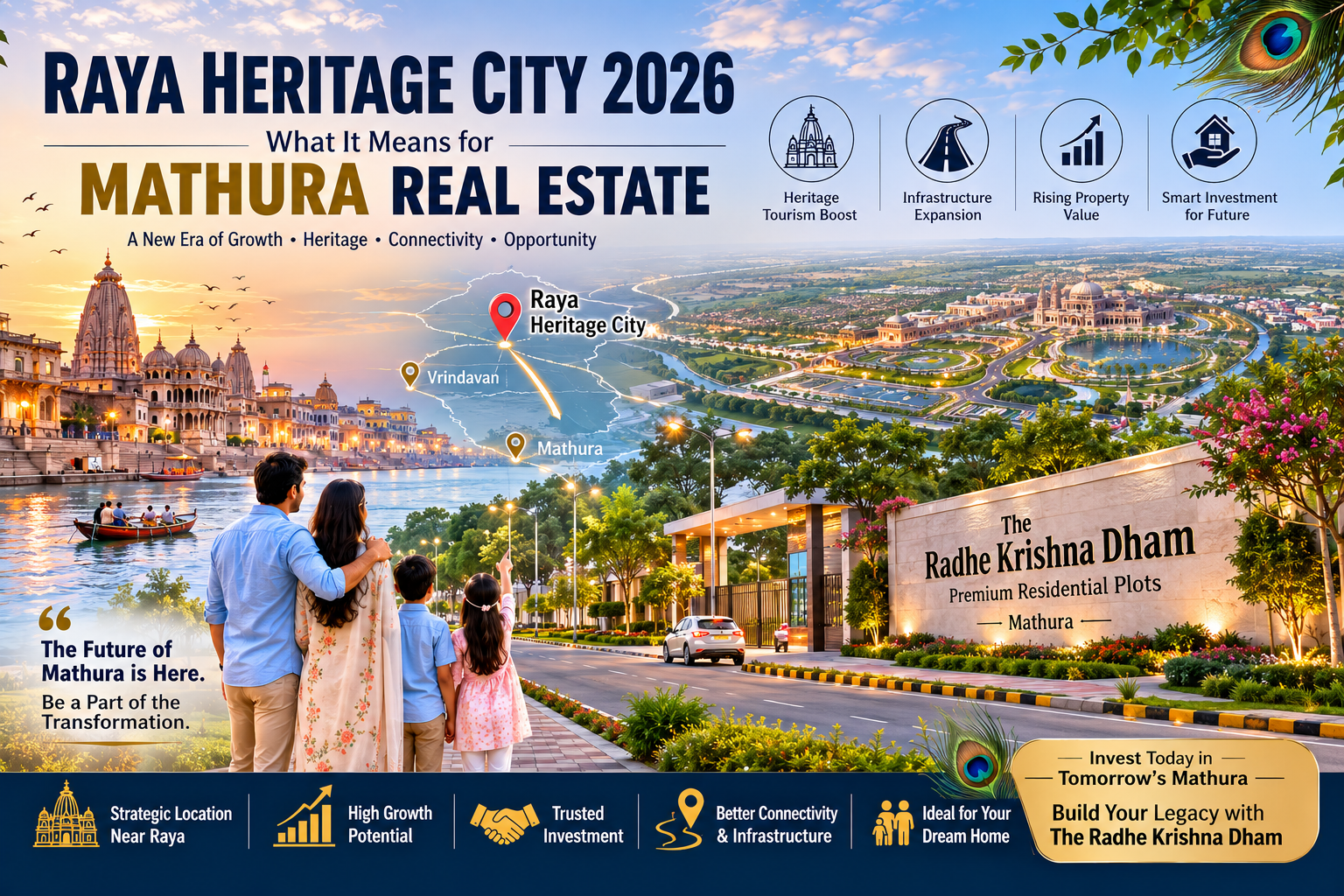
Raya Heritage City 2026: What It Means for Mathura Real Estate & Plot Buyers

Introduction

Something interesting is happening around Mathura in 2026.

For generations, Mathura and Vrindavan have been primarily associated with temples, pilgrimage, festivals and the timeless culture of Braj. Today, however, the region is increasingly being discussed in another context: large-scale infrastructure and real estate development.

One of the biggest developments attracting attention is Raya Heritage City.

The proposed project near Raya in Mathura district is being advanced by the Yamuna Expressway Industrial Development Authority (YEIDA), with a vision that combines heritage, tourism, hospitality, cultural infrastructure and urban development. YEIDA has reviewed the project and is moving forward with a PPP-oriented development approach.

For someone considering Buy Plots in Mathura, the important question isn't simply whether Raya Heritage City will become successful.

The bigger question is:

What does a major tourism-led development mean for the wider Mathura property market?

Let's explore.


What Is Raya Heritage City?

Raya Heritage City is a proposed heritage and tourism-focused development in the Raya area of Mathura district.

Reports have described a planned development of approximately 753 acres, with the broader Raya Urban Centre forming part of the region's longer-term planning framework.

The concept is particularly interesting because it isn't being positioned simply as another residential colony.

The broader vision includes elements connected with:

  • Religious tourism
  • Heritage
  • Hospitality
  • Wellness
  • Cultural activities
  • Commercial development
  • Residential requirements
  • Tourism infrastructure

The proposed Heritage City has also been associated with features such as a pilgrimage gateway, cultural spaces, hotels, wellness facilities and other tourism-oriented infrastructure.

That combination could potentially change how people view the surrounding region.


Why Is Raya Suddenly Important for Property Buyers?

Real estate markets often evolve around more than one factor.

A location becomes interesting when several forces begin working together:

Connectivity + Tourism + Infrastructure + Employment + Housing Demand

Raya is becoming part of that conversation.

The YEIDA Phase II draft master plan describes the Raya Urban Centre as strategically positioned near the Mathura-Vrindavan region and highlights its potential for hospitality, healthcare, education, recreation and tourism-related economic activity.

This is important because infrastructure doesn't operate in isolation.

When visitors increase, businesses need space, businesses grow, workers need housing, housing demand rises, residential development follows.

And when an area becomes easier to access, more buyers begin considering it for second homes, retirement and long-term ownership.

That is the development cycle property investors watch closely.


Mathura Is Moving From Pilgrimage Destination to Multi-Purpose Destination

Mathura's spiritual identity isn't going anywhere.

That's actually one of its biggest strengths.

The city already possesses something many emerging real estate destinations spend years trying to create: a powerful cultural identity and established tourism demand.

Now infrastructure and urban planning are being added to that foundation.

Recent reporting has highlighted a broader infrastructure push around Vrindavan and the Braj region, with significant planned and ongoing projects connected to tourism and connectivity.

This creates an interesting proposition for property buyers.

Instead of choosing between:

spiritual lifestyle

and

modern infrastructure

buyers may increasingly be able to find both within the broader Mathura-Vrindavan region.


What Could This Mean for Residential Plots in Mathura?

This is where things become particularly relevant for families.

Large infrastructure projects can influence surrounding real estate through several channels.

1. Improved Accessibility

Better roads and regional connectivity can make previously overlooked areas more practical for residents and investors.

2. Increased Tourism

More tourism infrastructure can encourage longer stays and create demand for hospitality, retail and residential services.

3. Business Activity

Hotels, restaurants, cultural venues, retail businesses and service providers can generate additional economic activity.

4. Housing Demand

As an area's economic activity increases, demand for housing can also expand.

5. Lifestyle Demand

Some buyers aren't looking for a conventional investment alone.

They want a place where they can eventually live.

That's where Residential Plots in Mathura can become relevant.


Why Plot Buyers Should Look at the Bigger Picture

A common mistake in property buying is focusing exclusively on today's surroundings.

A smarter approach is to ask:

What could this location look like five or ten years from now?

That doesn't mean assuming every announced project will be completed exactly as planned.

Instead, buyers should study:

  • Official development plans
  • Road connectivity
  • Land-use planning
  • Existing infrastructure
  • Nearby commercial activity
  • Tourism trends
  • Developer credibility
  • Legal status of the property

The Mathura-Vrindavan Development Authority provides online services related to property details, mutation, building-plan approvals and other development functions, making official verification an important part of responsible property research.


The Important Difference Between a Project Announcement and Reality

This point deserves attention.

Real estate buyers should never purchase land solely because they hear about a large upcoming development.

A proposed infrastructure project can take years to execute.

Plans can change.

Timelines can move.

Land acquisition and approvals can take time.

Therefore, Raya Heritage City should be viewed as one development factor within a larger investment analysis, not as a guarantee of property appreciation.

This is particularly important for first-time investors.

The strongest investment decision combines enthusiasm about future development with careful verification of what exists today.


What Should You Check Before Buying a Plot Near a Growth Corridor?

If you're researching Best Plots in Mathura, don't stop at the brochure.

Use this checklist.

Check 1: Legal Ownership

Verify the title and ownership history.

Check 2: Land Use

Confirm that the intended use of the land is appropriate for your purpose.

Check 3: Registry

Understand the registration process and whether the property can legally be transferred.

Check 4: Development Approvals

Go through with the relevant authority records and approvals.

Check 5: Physical Connectivity

Visit the site rather than relying entirely on maps.

Check 6: Surrounding Development

Look at what is actually being constructed nearby.

Check 7: Developer Track Record

Research the company selling the property.

Check 8: Total Cost

Don't evaluate a plot using the headline price alone.

Consider registration, development charges, infrastructure costs and other applicable expenses. @


Why Planned Communities Can Be Attractive to Families

A plot becomes more useful when it is part of a properly planned community.

Families often look for:

  • Wide roads
  • Green spaces
  • Gated surroundings
  • Organized plots
  • Accessibility
  • Peaceful surroundings
  • Documentation support

These factors can make the difference between simply owning land and owning land that is suitable for a future home.


Where The Radhe Krishna Dham Fits Into This Conversation

For families exploring Buy Plots in Mathura, The Radhe Krishna Dham is positioned around a simple idea:

own land in a peaceful environment while remaining connected to the growth of Mathura.

The project offers premium residential plots with features including:

✅ Gated Community

Wide Internal Roads

Green & Peaceful Environment

Clear Title & Registry Support

Excellent Connectivity

The project also appeals to a different kind of buyer.

Not everyone wants a high-rise apartment.

Some families want their own piece of land where they can eventually create a home according to their lifestyle.

For others, the goal may be to secure a long-term family asset.


Is 2026 the Right Time to Buy Property in Mathura?

There is no universal answer.

The right time depends on:

  • Your budget
  • Investment horizon
  • Financial stability
  • Intended use
  • Location
  • Legal due diligence
  • Project quality

However, 2026 is certainly an interesting period to study Mathura real estate because several development themes are converging.

The region is seeing continued attention toward tourism, infrastructure and urban development, while large projects such as Raya Heritage City are adding another layer to the area's long-term growth story.

For buyers, that makes research more important than ever.


Frequently Asked Questions

What is Raya Heritage City?

Raya Heritage City is a proposed heritage and tourism-oriented development in the Raya area of Mathura district, being advanced through YEIDA's planning and development framework.

Will Raya Heritage City increase property prices in Mathura?

It is too early to guarantee any specific price impact. Large infrastructure and tourism projects can influence demand, but actual property appreciation depends on execution, location, supply, demand and broader market conditions.

Should I buy a plot because of Raya Heritage City?

Not solely because of it. Buyers should independently verify the plot's title, land use, approvals, location, connectivity and developer credentials.

Why are people interested in residential plots in Mathura?

Mathura combines spiritual significance with growing tourism and infrastructure development. For many families, plots also provide flexibility to build a future home. @

Is Mathura suitable for a second home?

For some buyers, yes. The city's spiritual atmosphere, cultural importance and connectivity make it worth considering as a second-home destination, subject to individual lifestyle and budget requirements.


Final Thoughts

The story of Mathura's real estate market is becoming bigger than property prices.

It is increasingly about how a historic spiritual region adapts to modern tourism, infrastructure and urban development.

Raya Heritage City is one of the developments adding momentum to that conversation. At the same time, the wider Mathura-Vrindavan region continues to receive attention from homebuyers, hospitality businesses and investors.

For anyone considering Buy Plots in Mathura, the lesson is simple:

Don't just look at today's Mathura. Study tomorrow's Mathura too.

But while looking toward the future, keep your feet firmly on the ground.

Verify the documents.

Visit the property.

Understand the location.

Check the approvals.

And choose a development based on facts rather than hype.

For families seeking a combination of peaceful surroundings, planned development and the cultural atmosphere of Braj, The Radhe Krishna Dham offers an opportunity to explore residential plot ownership in Mathura as part of a longer-term family vision.

The future of Mathura may be taking shape today, but smart property decisions still begin with research.

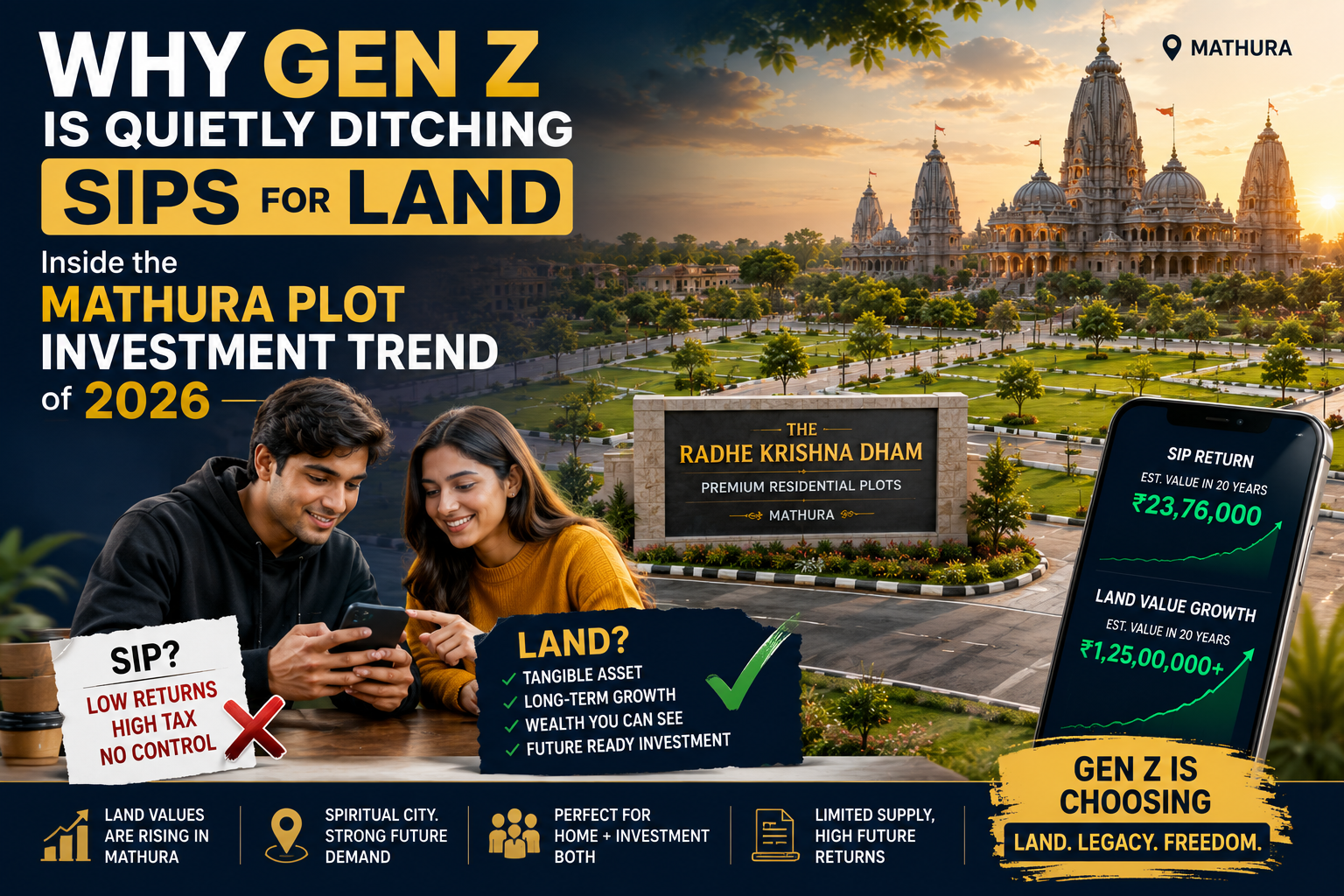
Why Gen Z Is Investing in Land in Mathura Instead of SIPs and Stocks (2026)

Introduction

Scroll through any finance page on Instagram right now and you'll see the same debate playing out in the comments: SIPs vs. stocks vs. gold vs. "just buy land, bro." But somewhere in the last year, that last option stopped being a joke. Buy plots in Mathura. Gen Z investors — the same generation that grew up watching their parents' EMIs stretch across decades — are increasingly putting money into plots in spiritually and culturally significant destinations like Mathura, instead of parking everything in mutual funds they don't fully understand. This isn't nostalgia. It's a calculated, low-noise investment move — and The Radhe Krishna Dham by Luxia Developersits right at the center of this shift: residential plots in Mathura, in one of India's fastest-growing pilgrimage and tourism corridors. Here's why this generation is paying attention, and why land in Mathura specifically is becoming the asset nobody's talking about loudly, but everybody's quietly buying.

1. Gen Z Doesn't Trust "Invisible" Assets Anymore

A stock chart or a mutual fund NAV is a number on a screen. A plot of land is something you can visit, walk on, fence, and show your family. After watching market crashes, crypto wipeouts, and endless finfluencer disclaimers, many young investors now prioritize assets that are:
  • Tangible and verifiable
  • Free from daily volatility anxiety
  • Simple to explain to family and friends
Land ownership checks every box. You don't need a Bloomberg terminal to understand that a plot in a growing region tends to appreciate — you just need to watch the region grow.

2. Mathura Is No Longer "Just a Pilgrim Town"

Mathura and the wider Mathura-Vrindavan belt have quietly become one of India's most active development zones — temple corridors, improved road connectivity, tourism infrastructure, and rising footfall are reshaping the region year over year. For Gen Z investors scanning for undervalued locations before prices catch up, this combination of spiritual significance + active infrastructure growth is exactly the setup they look for. It's the same pattern early investors chased in emerging suburbs of bigger cities — except here it's backed by centuries of cultural pull that isn't going anywhere.

3. The "Buy Once, Escape Often" Lifestyle Trend

A recurring theme in Gen Z lifestyle content is the desire for a personal retreat space — somewhere outside the city to disconnect, recharge, or host a small gathering, without the commitment of a second home in an expensive metro. Owning a plot in Mathura fits this perfectly. It's:
  • Close enough to Delhi-NCR for weekend trips
  • Set in a spiritually calming environment
  • Flexible — build now, later, or hold as an appreciating asset
This "buy once, escape often" mindset is becoming a genuine sub-trend among young professionals who want ownership without the burnout of a full home-building project right away.

4. Land as the Original Inflation Hedge

Gen Z has grown up hearing about inflation eating into savings. Unlike a fixed deposit that loses real value over time, land historically holds and grows value as regions develop. Plots in a location like Mathura, where infrastructure and tourism activity are actively expanding, offer a hedge that doesn't require constant monitoring — a stark contrast to checking a trading app five times a day.

5. Fractional Ownership Culture Is Making Land Feel Accessible

A big reason older generations saw land as "out of reach" was the assumption that you needed massive capital upfront. That perception is fading. Structured residential plot projects — with clear pricing, phased payment options, and defined plot sizes — are making land entry points far more approachable for first-time young investors. The Radhe Krishna Dham is structured exactly this way: defined residential plots, transparent documentation, and a project designed for buyers who are serious but not necessarily ultra-wealthy.

6. Instagram-Worthy Isn't a Bad Thing — It's a Demand Signal

Gen Z buying decisions are heavily influenced by aesthetics and shareability, and spiritual tourism destinations are having a real cultural moment — temple architecture, ghats, sunrise reels, and devotional content consistently perform well across platforms. That online attention translates into real-world footfall. More visitors means more long-term demand for stays, homes, and eventually, land — a dynamic smart investors watch closely.

7. Community and "Vibe" Now Matter as Much as Location

Younger buyers aren't just asking "where" — they're asking "who else is here" and "what does this place feel like." A residential plot community in a devotional setting like Mathura offers something metro apartments can't: a slower pace, a spiritual undertone, and a shared sense of purpose among fellow plot owners. This community-first mindset is increasingly shaping where Gen Z chooses to put down long-term roots, even as a secondary or future home.@

8. Digital-First Documentation Builds Trust With a Digital-First Generation

One historic hesitation around land investment was the paperwork — unclear titles, informal deals, and opaque processes. Gen Z, having grown up with UPI, e-KYC, and digital contracts, expects the same clarity from real estate. Projects that offer clear documentation, verified layouts, and straightforward buying processes remove the single biggest trust barrier for younger buyers considering their first land purchase.

9. Parents Approve — Which Quietly Matters More Than You'd Think

For a generation often accused of impulsive spending, land investment is one of the rare financial decisions that earns immediate approval from parents and grandparents. It reads as responsible, culturally rooted, and long-term — a combination that makes it an easier "yes" in family conversations about money, especially when the location itself carries devotional meaning.

10. The Early-Mover Advantage Is Still Open — But Closing

Every growth corridor has a window where prices are still accessible before wider recognition drives them up. Mathura's ongoing development — from religious tourism initiatives to regional connectivity upgrades — suggests that window is active right now, not five years from now. For a generation obsessed with not missing the next big thing, that timing alone is a compelling reason to look seriously at plots in Mathura before broader demand catches up. @

Conclusion

Gen Z's relationship with money is evolving — less blind trust in traditional instruments, more preference for tangible, understandable, culturally meaningful assets. Land in a growing spiritual destination like Mathura checks every box this generation is quietly prioritizing: authenticity, appreciation potential, community, and a story worth telling. The Radhe Krishna Dham by Luxia Developer offers exactly this opportunity — residential plots in Mathura, backed by transparent documentation and positioned in one of India's most actively developing pilgrimage regions. If you're exploring your first real estate investment — or simply want an asset that feels as meaningful as it is smart — this might be the trend worth acting on before everyone else catches up. 📞 +91 9810505543 | 🌐 theradhekrishnadham.com

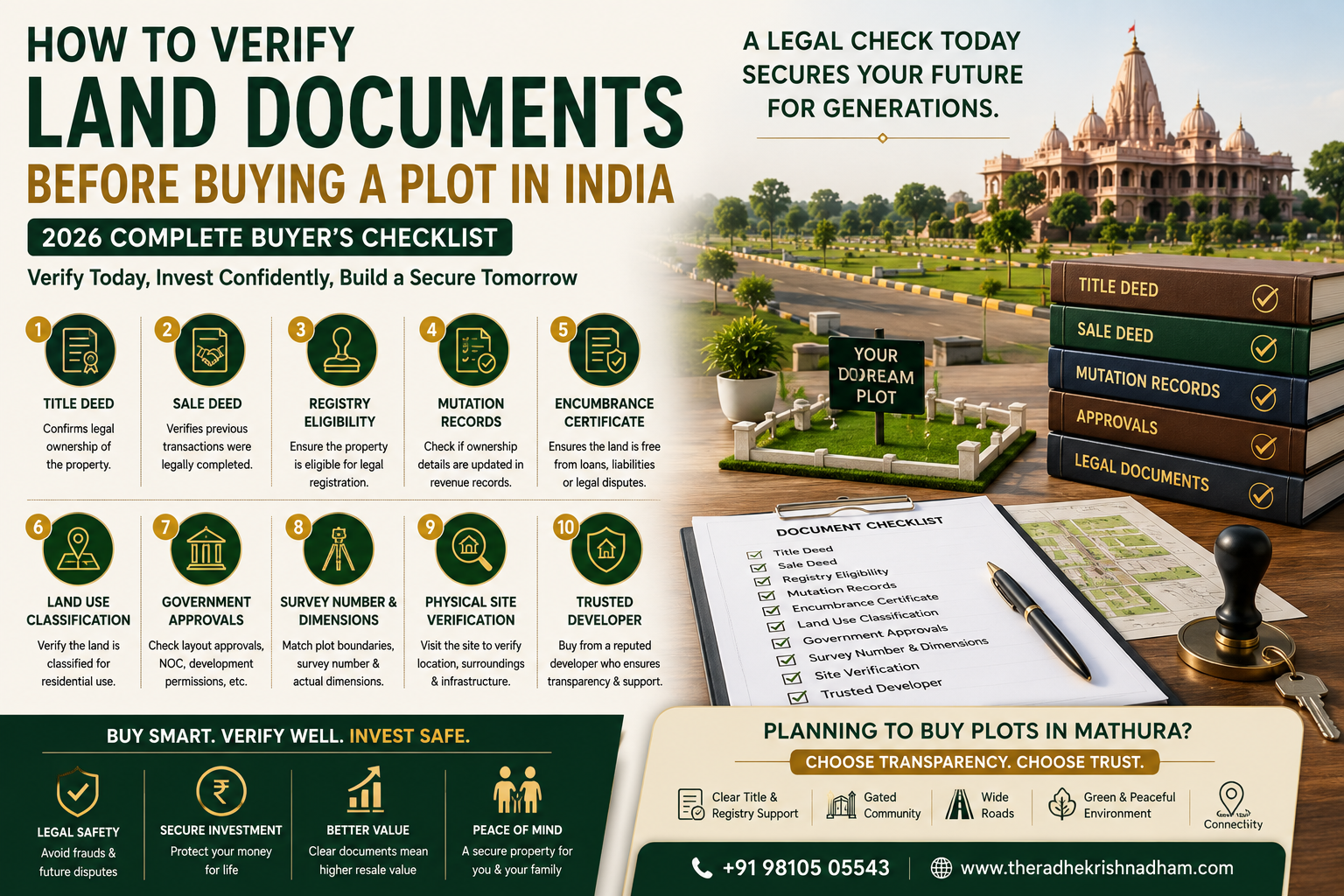
How to Verify Land Documents Before Buying a Plot in India (2026 Complete Checklist)

Buying a Plot? Verify the Documents Before You Invest

Buying a residential plot is a dream for many Indian families. Whether you're planning to build your dream home, secure your family's future, or make a long-term investment, purchasing land is a major financial decision.

However, one mistake can turn a valuable investment into a legal headache.

In recent years, the demand for Buy Plots in Mathura has increased due to better infrastructure, growing tourism, and rising residential development. While these opportunities are exciting, they also make it more important than ever to verify every legal document before finalizing a purchase.

Many buyers focus on the location, price, and future appreciation but overlook the legal aspects of the property. That's why understanding the document verification process is essential.

This guide explains the key land documents every buyer should verify before purchasing a residential plot in India.


Why Document Verification Matters

Legal verification protects your investment.

It helps you:

  • Avoid ownership disputes
  • Prevent fraud
  • Ensure smooth registration
  • Confirm the seller's legal rights
  • Reduce future legal complications
  • Improve resale value

A legally verified property gives buyers confidence and peace of mind.


1. Verify the Title Deed

The Title Deed is one of the most important legal documents.

It proves that the seller has the legal ownership rights to transfer the property.

Before purchasing, confirm:

  • Seller's name matches government records
  • Ownership is clear
  • No legal disputes exist
  • Property description matches the actual plot

If the title is unclear, consult a qualified property lawyer before proceeding.


2. Check the Sale Deed

The Sale Deed records the legal transfer of ownership.

It confirms that previous transactions were completed legally.

Carefully review:

  • Seller information
  • Buyer information
  • Property dimensions
  • Survey number
  • Registration details
  • Previous ownership records

The Sale Deed should be properly registered with the local Sub-Registrar Office.


3. Confirm Registry Eligibility

Before buying any residential plot, verify whether the property is eligible for legal registration.

Ask for:

  • Registry status
  • Registration history
  • Applicable government approvals

A plot that cannot be legally registered should always raise questions.


4. Verify Mutation Records

Mutation records show that the ownership details have been updated in the local revenue records after a property transfer.

Although mutation does not establish ownership, it confirms that government land records reflect the current owner.

Always ensure mutation records are updated before purchasing.


5. Check the Encumbrance Certificate

An Encumbrance Certificate (EC) helps buyers determine whether the property has any legal or financial liabilities.

It shows whether the land is:

  • Mortgaged
  • Under legal dispute
  • Used as collateral
  • Involved in pending transactions

A clear Encumbrance Certificate provides additional confidence before investing.


6. Verify Land Use Classification

Not every piece of land can be used for residential construction.

Always verify whether the land is classified as:

  • Residential
  • Agricultural
  • Commercial
  • Industrial

Buying residential plots with appropriate land-use permissions helps avoid future legal issues.


7. Check Government Approvals

Government approvals are equally important.

Depending on the project, verify approvals related to:

  • Layout plans
  • Development permissions
  • Local planning authority
  • Road access
  • Utility infrastructure

Proper approvals indicate that the development follows applicable planning regulations.


8. Verify Survey Number and Plot Dimensions

The physical plot should match official records.

Cross-check:

  • Survey number
  • Plot size
  • Boundary measurements
  • Site location

Small discrepancies today can become significant legal issues later.

A professional site survey can provide additional assurance.


9. Visit the Site Personally

Documents tell only part of the story.

A personal site visit allows buyers to verify:

  • Actual location
  • Road connectivity
  • Neighborhood
  • Infrastructure
  • Accessibility
  • Development progress

Never rely only on brochures or online photographs.


10. Purchase from a Trusted Developer

Choosing a reputable developer reduces many risks associated with property transactions.

A transparent developer typically provides:

  • Proper documentation
  • Clear communication
  • Legal assistance
  • Registration support
  • Professional customer service

Always research the developer's reputation before making your final decision. @


Why Buyers Trust The Radhe Krishna Dham

Purchasing a plot becomes easier when documentation and transparency are prioritized.

At The Radhe Krishna Dham, buyers receive professional guidance throughout the property buying process.

Project Highlights

  • Premium Residential Plots
  • Clear Title & Registry Support
  • Gated Community
  • Wide Internal Roads
  • Green & Peaceful Environment
  • Excellent Connectivity
  • Located in the sacred city of Mathura, the project combines planned infrastructure with a transparent buying experience for families and investors.

Land Document Verification Checklist

Before purchasing any residential plot, confirm the following:

  • Title Deed Verified
  • Sale Deed Reviewed
  • Registry Eligibility Confirmed
  • Mutation Records Updated
  • Encumbrance Certificate Checked
  • Land Use Verified
  • Government Approvals Available
  • Survey Number Matched
  • Physical Site Visit Completed
  • Trusted Developer Selected
  • Following this checklist can help buyers make informed and confident decisions. @

Frequently Asked Questions

Which document proves ownership of a plot?

The Title Deed is one of the primary documents that establishes legal ownership. Buyers should also review the Sale Deed and related government records.


What is an Encumbrance Certificate?

An Encumbrance Certificate indicates whether a property has financial liabilities, legal disputes, or existing mortgages. It helps buyers verify that the property has a clear transaction history.


Why is mutation important?

Mutation updates ownership details in local land revenue records after a property transfer. It ensures that government records reflect the current owner.


Can I buy a plot without checking government approvals?

It is strongly recommended to verify all applicable approvals before purchasing any property to avoid legal and regulatory issues.


Why should I visit the property before buying?

A site visit helps verify the actual condition of the land, surrounding infrastructure, road access, neighborhood, and whether the physical property matches the documents.


Final Thoughts

Buying land is not only about choosing the right location. It is equally important to ensure that every legal document has been carefully verified.

A well-informed buyer is far less likely to face ownership disputes, registration issues, or unexpected legal complications.

If you're planning to Buy Plots in Mathura, choosing a professionally planned project like The Radhe Krishna Dhamcan provide both transparency and confidence throughout your property-buying journey.


About the Author

This article has been prepared by the real estate research team at The Radhe Krishna Dham. Drawing on industry best practices, property documentation standards, and buyer awareness, our goal is to help families make informed, transparent, and confident real estate decisions.

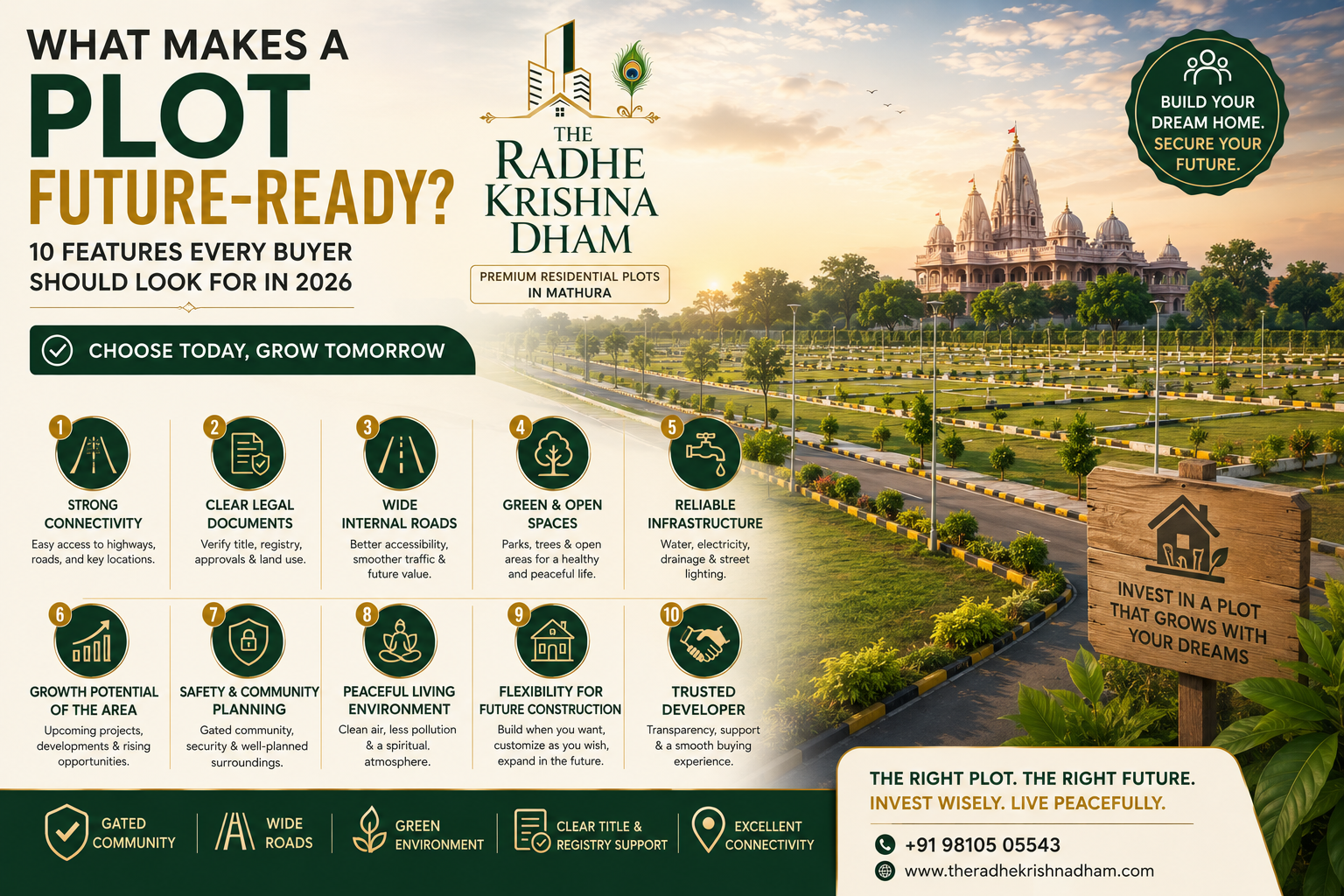
What Makes a Plot Future-Ready? 10 Features Every Buyer Should Look For in 2026

Buying a Plot Isn't Just About Location Anymore

For many Indian families, buying a residential plot is one of the most important financial decisions they will ever make. While location and price remain key factors, today's buyers are becoming more informed. They now look beyond the basic details and ask a more important question: Buy Plots in Mathura. Continue reading "What Makes a Plot Future-Ready? 10 Features Every Buyer Should Look For in 2026"

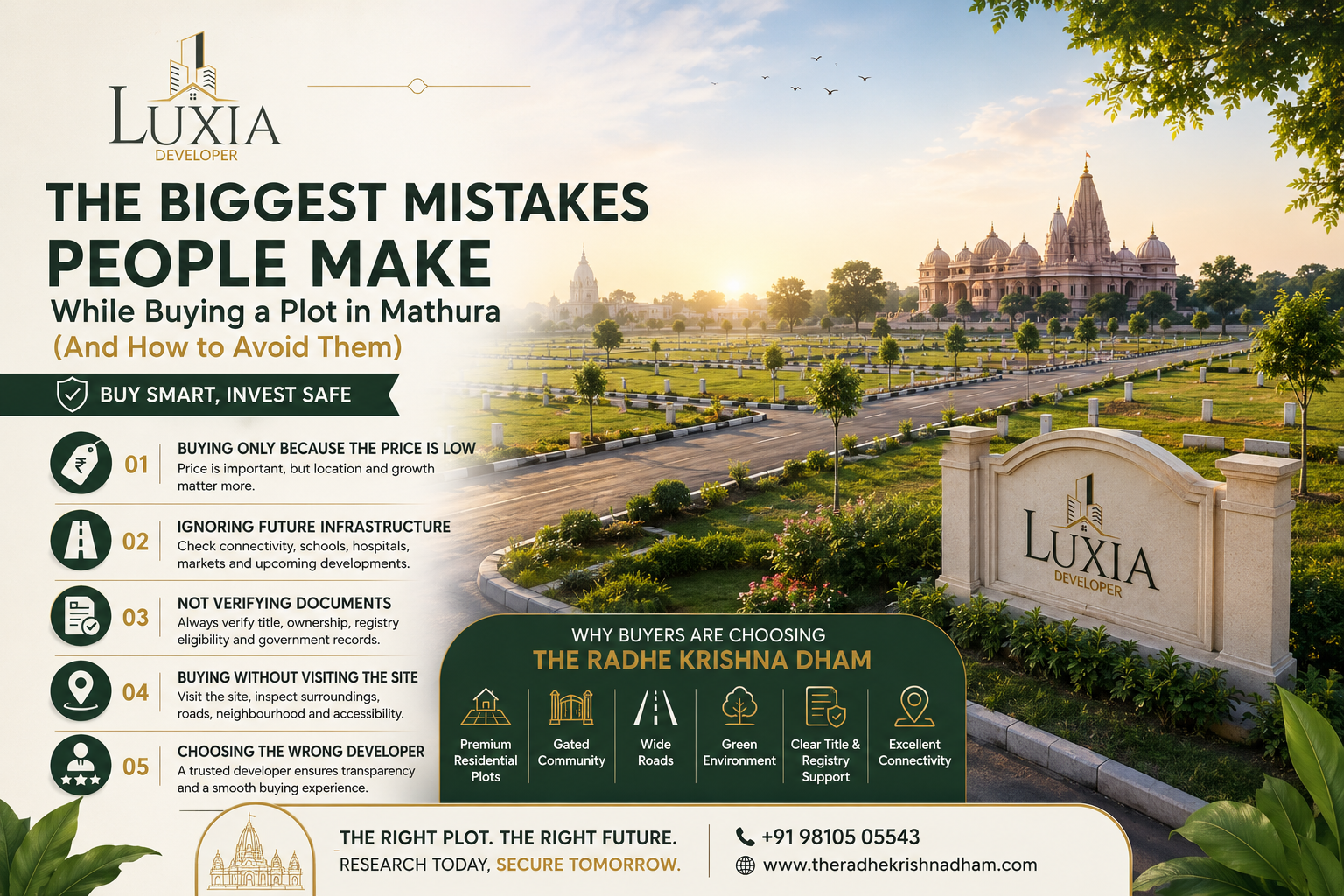
The Biggest Mistakes to Avoid When Buying Plots in Mathura (2026 Buyer’s Guide)

Why This Guide Matters in 2026

Buying land is one of the biggest financial decisions most families make. Unfortunately, many buyers focus only on the price and overlook important legal and practical factors. In recent years, demand for buy plots in Mathura has increased because of infrastructure growth, religious tourism, and better connectivity. However, rising demand has also created confusion for first-time buyers. This guide explains the most common mistakes people make while purchasing a residential plot and how you can avoid them.

Mistake 1: Buying Only Because the Price Looks Attractive

A low price may seem appealing, but it should never be the only reason to invest. Before purchasing, ask yourself:
  • Is the location developing?
  • Are roads easily accessible?
  • Will the area grow over the next 5 to 10 years?
  • Does the project have clear ownership documents?
A slightly higher investment in the right location often delivers better long-term value.

Mistake 2: Ignoring Future Infrastructure

Property appreciation depends heavily on infrastructure. Always check:
  • Highway connectivity
  • Schools
  • Hospitals
  • Markets
  • Public transport
  • Upcoming government development
Areas with planned infrastructure generally appreciate faster.

Mistake 3: Not Verifying Documents

Always verify:
  • Clear Title
  • Registry eligibility
  • Ownership history
  • Site boundaries
  • Government records where applicable
Document verification protects your investment.

Mistake 4: Buying Without Visiting the Site

Online photos never tell the complete story. Visit the project and inspect:
  • Road quality
  • Plot surroundings
  • Neighbourhood
  • Green spaces
  • Accessibility
A site visit provides confidence before making a decision.

Mistake 5: Choosing the Wrong Developer

A trusted developer offers transparency, proper documentation, and timely assistance throughout the buying process. Always research the developer before investing. @

Why Buyers Are Choosing The Radhe Krishna Dham

The Radhe Krishna Dham has been planned to provide buyers with both peace of mind and long-term value.

Project Highlights

Premium Residential Plots Gated Community Wide Roads Green Environment Clear Title & Registry Support Excellent Connectivity Located in the sacred city of Mathura, the project combines modern planning with a peaceful atmosphere.

Frequently Asked Questions

What should I check before buying a plot?

Verify legal documents, visit the site, understand future infrastructure plans, and evaluate the developer's credibility.

Is Mathura a good place to buy a residential plot?

Yes. Growing tourism, infrastructure improvements, and increasing residential demand make Mathura a promising destination.

Why are plotted developments becoming popular?

They offer flexibility, long-term appreciation, lower maintenance, and complete ownership. @

Final Thoughts

Buying a plot should never be an emotional decision alone. A well-informed investment backed by proper research can provide both financial growth and a better lifestyle. If you're looking for the best plots in Mathura, choosing a well-planned community like The Radhe Krishna Dham can help you build a secure future while enjoying the spiritual charm of Braj.

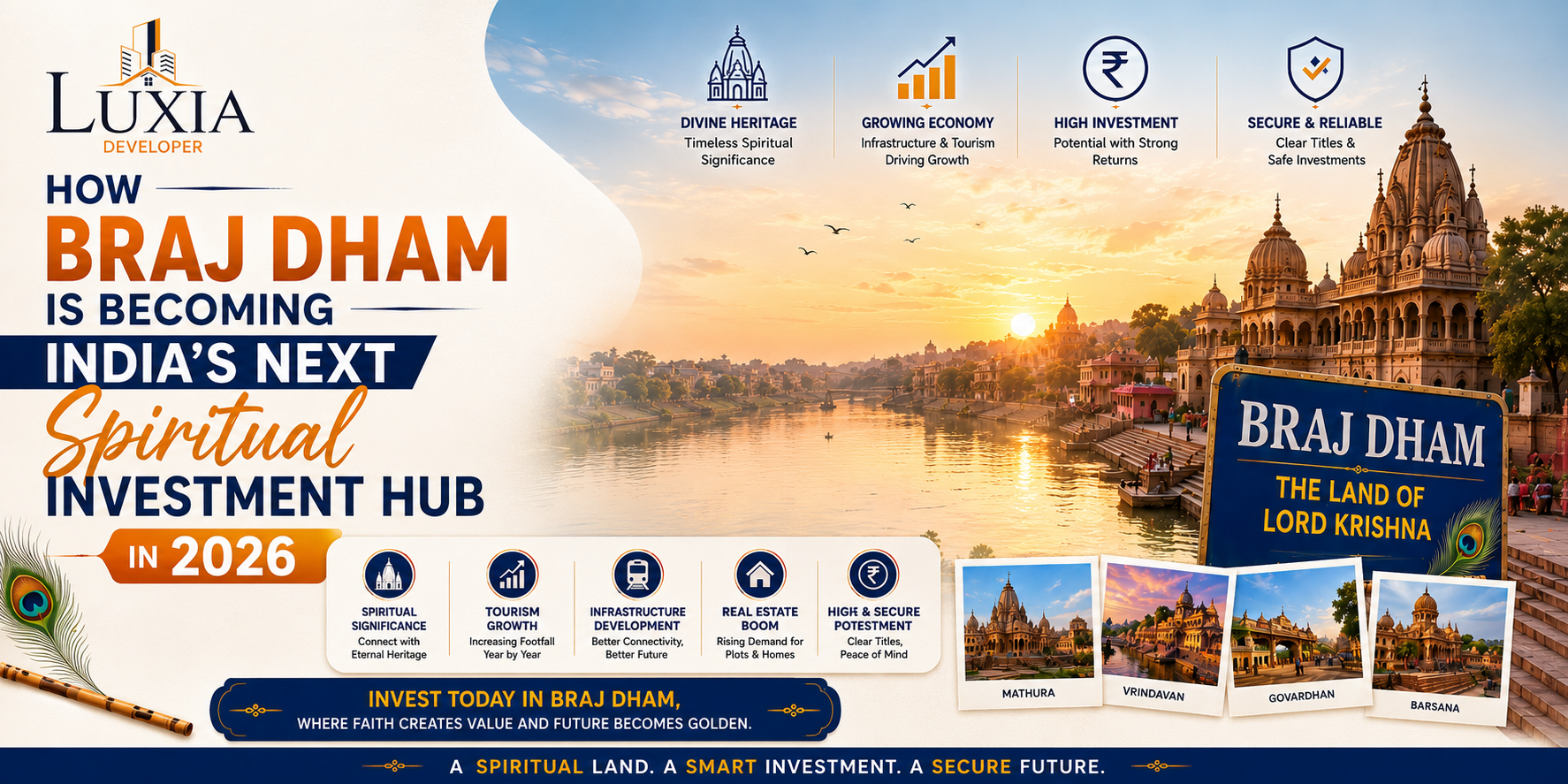
Braj Dham Investment 2026: Why Smart Buyers Are Investing in Plots in Mathura

For centuries, Braj Dham has been known as the sacred land of Lord Krishna. Every year, millions of devotees visit Mathura, Vrindavan, Govardhan, Barsana, and surrounding regions to experience the spiritual energy of this divine destination. Continue reading "Braj Dham Investment 2026: Why Smart Buyers Are Investing in Plots in Mathura"