
Introduction: Braj Is Being Experienced Differently in 2026
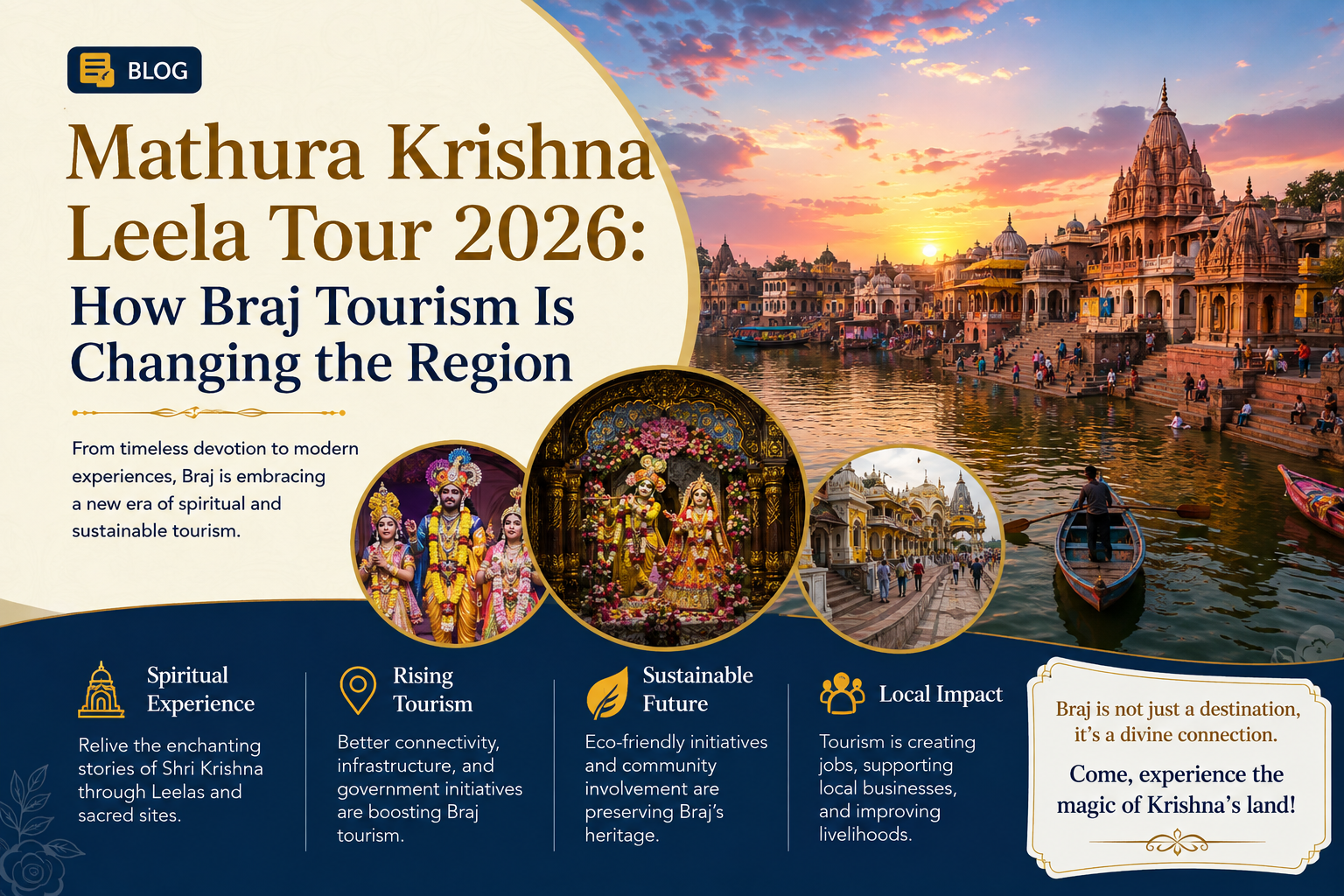
For centuries, people have travelled to Mathura and Vrindavan seeking darshan, peace and a connection with the stories of Shri Krishna. But the way people experience Braj is changing. In August 2026, the Uttar Pradesh State Tourism Development Corporation launched a three-day Krishna Leela tour package connecting Mathura, Vrindavan, Gokul and Barsana. The package is designed around guided sightseeing, accommodation, refreshments and local transfers, bringing several important destinations of Braj together as one travel experience. The development is significant because it reflects a broader shift in how spiritual tourism is being organised. Instead of treating Mathura, Vrindavan, Gokul and Barsana as completely separate stops, the new approach connects them through a single cultural and spiritual journey. For visitors, that means convenience. For local businesses, it can mean more opportunities. And for families considering Buy Plots in Mathura, it creates another reason to pay attention to how the wider Braj region is evolving.What Is the New Krishna Leela Tour?
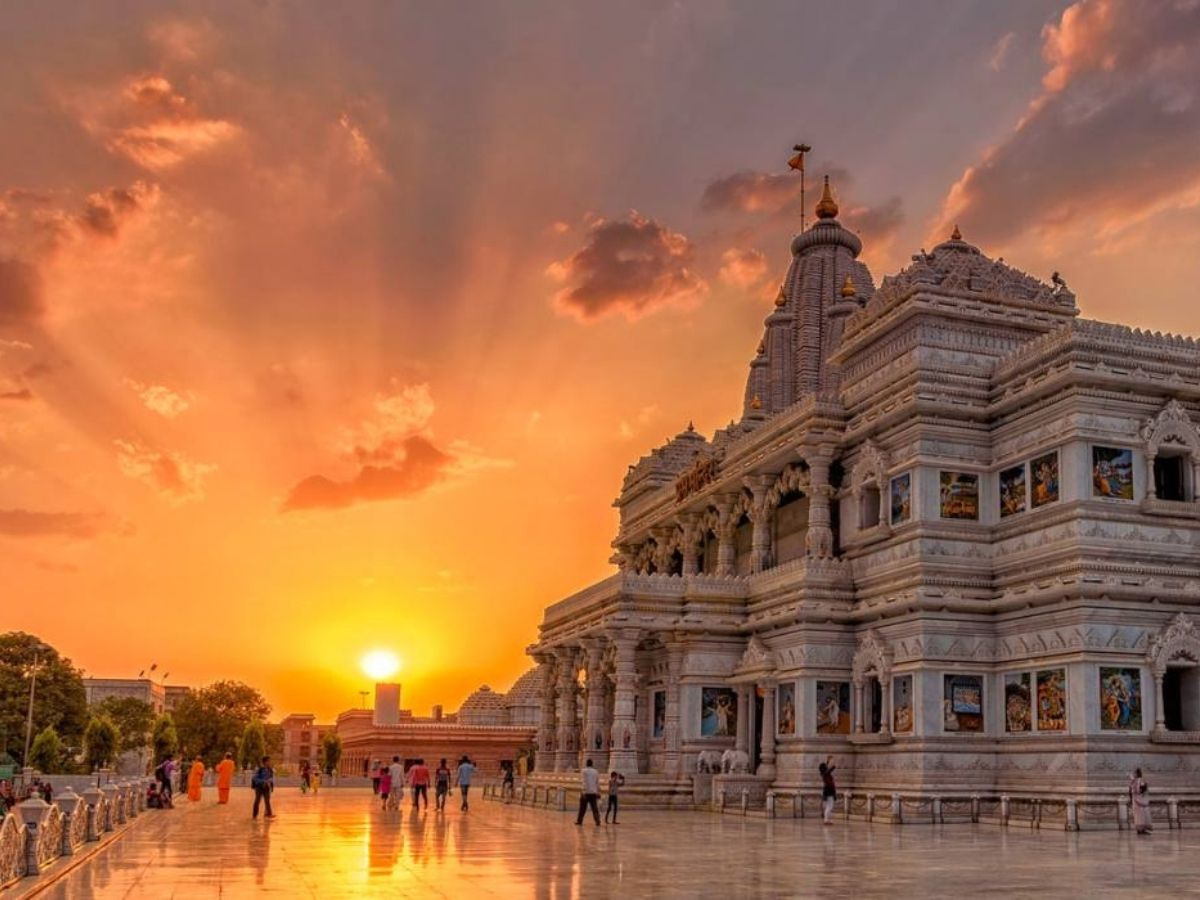
The new UPSTDC package is a three-day journey covering major religious and cultural destinations across the Braj region. The itinerary includes prominent places in Vrindavan such as Banke Bihari Temple, Rang Ji Temple, Nidhivan and Akshaya Patra Temple. Mathura's Krishna Janmabhoomi, Dwarkadheesh Temple, Vishram Ghat and Bhuteshwar Temple are also included, while the wider itinerary reaches Govardhan and Barsana. The important idea isn't simply the list of temples. It is the connection between destinations. Tourism is increasingly being packaged around experiences rather than individual attractions. That can make a destination feel larger, richer and more accessible to people who are visiting for the first time.Why This Matters for Mathura
Imagine someone visiting Braj for the first time. Previously, they may have planned a short visit focused on one or two famous temples. Now, an organised circuit encourages visitors to discover multiple parts of the region. That creates a different tourism pattern. A visitor who spends more time in the region is likely to interact with more:- Hotels
- Restaurants
- Local transport
- Shops
- Guides
- Cultural experiences
- Religious services
- Local businesses
From Pilgrimage to Experience-Based Tourism
This is one of the most interesting trends happening across spiritual destinations in India. People still come for faith. But many visitors also want an experience. They want to understand the stories, explore local culture, photograph historic place, experience traditional food, music and festivals. Families want comfortable travel. Younger travellers want experiences they can share and remember. The new Krishna Leela circuit fits naturally into this changing travel behaviour. It turns the geography of Braj into part of the experience. Mathura tells one chapter. Gokul tells another. Vrindavan adds another. Barsana adds another. Together, they create a much larger story.What Does This Mean for Local Businesses?
Tourism has a multiplier effect. A tourist doesn't only spend money on a hotel. They may also use local transport, eat at restaurants, purchase products, visit markets and hire local services. When visitor activity expands across several destinations, economic opportunities can spread beyond one central location. This is why tourism infrastructure is relevant to property discussions. A growing tourism economy can create demand for commercial spaces, hospitality facilities, services and eventually housing. However, buyers should remember one important rule: Tourism growth is a positive signal, not a guaranteed property-return formula. A property's future performance still depends on location, legal status, infrastructure, supply, demand and many other factors.Mathura Is Becoming More Connected to the Wider Braj Economy
The Krishna Leela package is particularly interesting because it doesn't isolate Mathura. It connects the city with the broader Braj circuit. This matters because modern cities don't grow only within their administrative boundaries. Economic activity often develops across connected destinations. A visitor staying in one place may travel to another. A business serving tourists in one city may source employees or supplies from nearby areas. A family may choose to live in one location while working or doing business in another. That makes regional connectivity increasingly important when evaluating property.Why Residential Plots Can Fit Into This Larger Story
For a family, property isn't always about immediate rental income. Sometimes it is about having a place to call home, it is about retirement, it is about a second home. And sometimes it is simply about securing land for the next generation. This is where Residential Plots in Mathura become an interesting option for certain buyers. Unlike a ready-built apartment, a plot gives the owner flexibility over when and how to construct. A young family may purchase land today and build several years later. A person living outside Mathura may consider it for a future home. Someone with a spiritual connection to Braj may want a permanent base in the region. Different buyers can have completely different reasons for purchasing the same type of property.The Emotional Side of Owning Land in Braj
Real estate decisions are usually discussed using numbers. Price. Location. Connectivity. Appreciation. Size. But property in a place like Mathura has another dimension. For many Indian families, Braj carries an emotional connection that goes beyond conventional real estate logic. The names Mathura, Vrindavan, Gokul, Govardhan and Barsana are not simply locations on a map. They are part of stories passed from one generation to another. That can make owning a home or plot in the region feel different from owning property in an ordinary urban development. The financial decision should still be based on proper due diligence. But the emotional reason for choosing Braj can be equally meaningful.What Buyers Should Watch in Mathura in 2026
If you are researching <strong>Buy Plots in Mathura, don't look at one tourism announcement in isolation. Instead, watch several signals together.1. Tourism Footfall
Are visitors staying longer and exploring more destinations?2. Connectivity
Are roads and transportation links improving?3. Hospitality
Are new hotels and tourism facilities entering the market?4. Infrastructure
Are public and private developments expanding around established areas?5. Residential Demand
Are families actually looking for homes and plots in the region?6. Legal Development
Are local authorities approving and regulating planned developments? These indicators provide a much more useful picture than social-media claims about “guaranteed appreciation.”Infrastructure Is Still a Major Part of the Story
The tourism push is not happening in a vacuum. Government records show that Mathura-Vrindavan has been included in tourism infrastructure programmes, including the Mathura-Vrindavan Mega Tourist Circuit, a Tourist Facilitation Centre at Vrindavan and infrastructure development at Govardhan. The Mathura-Vrindavan Development Authority also continues to publish development-related works and tenders. Recent official tender listings include infrastructure work connected with residential schemes and road development in the Mathura-Vrindavan region. This combination is worth watching: Tourism + Infrastructure + Connectivity + Residential Development When these factors develop together, a city can gradually become more attractive not only to visitors but also to people considering long-term residence. @What Should You Check Before Buying a Plot?
The excitement around Mathura should never replace due diligence. Before purchasing a residential plot, buyers should verify:Clear Ownership</h3>
Understand who legally owns the property and review the title history.Land Use
Confirm that the land is permitted for the intended residential purpose.Registry
Understand whether the property is eligible for registration and what documentation is required.Approvals
Check the relevant development and local-authority records.Physical Location
Visit the actual site.Road Access
Don't assume that a road shown on a map will have the same condition on the ground.Surrounding Development
Look at what already exists rather than relying entirely on future promises.Developer Credentials
Research the developer and understand exactly what is included in the project. This approach protects buyers from turning a promising trend into an uninformed purchase.Why The Radhe Krishna Dham Is Relevant to This Conversation
For families exploring Plots in Mathura, The Radhe Krishna Dham is designed around the idea of planned residential plot ownership in the Mathura region. The project focuses on creating a residential environment where buyers can think beyond simply purchasing a piece of land. The objective is to provide a setting where families can eventually create their own homes and long-term memories. For some buyers, the attraction is the possibility of building a future residence. For others, it may be the opportunity to own land in a city with a deep spiritual and cultural identity. The right choice ultimately depends on the buyer's individual budget, purpose and due diligence.A New Kind of Braj Visitor Is Emerging
There is an interesting cultural shift taking place. The modern Braj visitor may be:- A lifelong devotee
- A young professional
- A family travelling together
- An NRI visiting India
- A senior citizen seeking peace
- A cultural traveller
- A weekend visitor
- A first-time explorer of Krishna's heritage
/>